
That's the problem. Many subcontractors assume their usual protections apply, until a payment dispute reveals otherwise. Mechanic's liens, the go-to remedy on private and state jobs, cannot attach to federal government property. When primes delay payment or a compliance question surfaces, subcontractors are often unprepared for how differently federal projects work.
This guide breaks down what makes you a federal subcontractor, the rights you actually have, the risks that catch people off guard, and how to protect your business before a dispute costs you money you can't recover.
Key Takeaways
- Federal FAR flow-down clauses can bind your subcontract automatically, even if unstated
- Mechanic's liens don't reach federal property; Miller Act bonds are your primary remedy
- Non-payment, compliance failures, and certification disputes drive most federal litigation
- A pre-signing contract review with litigation counsel prevents most of these problems
What Makes You a "Subcontractor" Under a Federal Contract
Under FAR 44.101, a subcontractor is any supplier, distributor, vendor, or firm furnishing supplies or services to a prime contractor or another subcontractor. FAR 3.502-1 defines it similarly for specific FAR subparts. Neither definition requires you to know your buyer holds a federal prime contract.
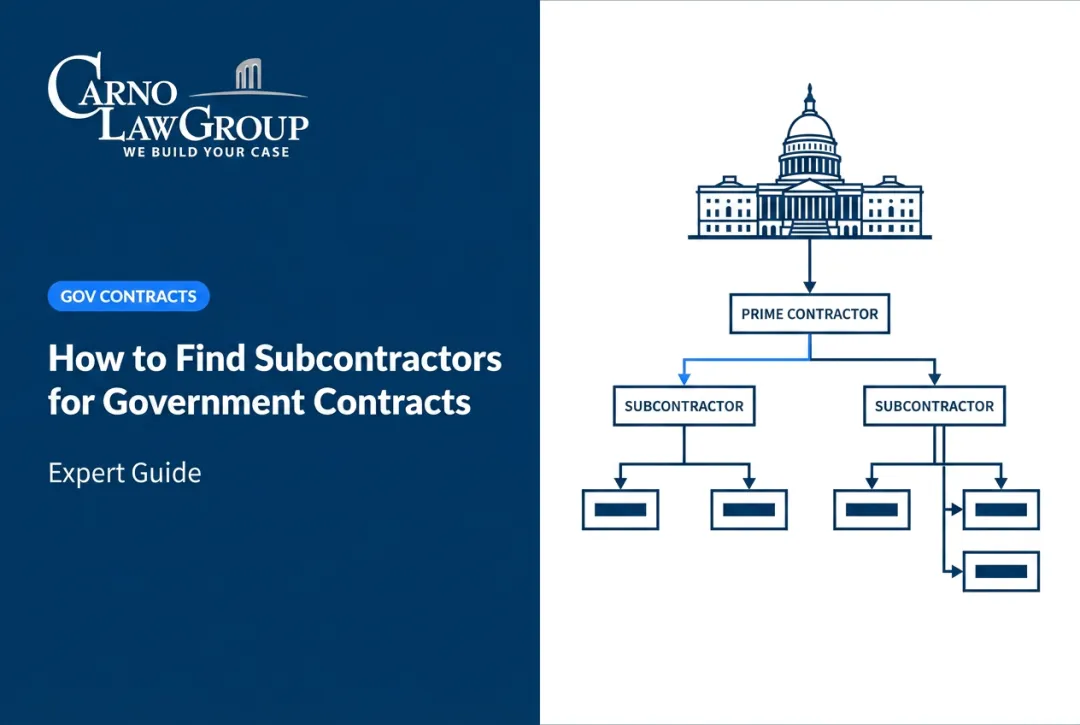
That distinction matters. A prime contractor holds the direct government agreement. A consultant may advise without ever furnishing goods or services used in contract performance. A subcontractor sits in between, bound by obligations it may never have negotiated.
The Two-Part Test Courts Use
Courts and agencies historically applied a nexus test to determine subcontractor status:
- Necessity to performance: does the good or service have a close connection to the efficiency or economy purpose of the federal contract?
- Ultimate use — is it actually consumed in performing that government contract?
Liberty Mutual Insurance Co. v. Friedman rejected subcontractor status for a workers' compensation insurer because the connection was too attenuated. By contrast, OFCCP v. Monongahela Railroad Company treated rail delivery of coal used to fuel a federal power obligation as sufficiently necessary. The takeaway: a vendor can be swept into subcontractor status without ever realizing its goods are feeding a federal job.
Dollar Thresholds That Trigger Added Rules
Beyond the nexus test, certain contract values automatically trigger added obligations regardless of how the relationship is characterized:
| Program | Coverage Threshold | Written Plan Threshold |
|---|---|---|
| Rehabilitation Act Section 503 | Contract exceeding $20,000 | 50+ employees and one contract of $50,000+ |
| VEVRAA | Contract of $200,000 or more | 50+ employees and one contract of $200,000+ |

Note: Executive Order 11246's affirmative-action mandate was revoked by EO 14173 effective January 21, 2025, so it no longer applies as a current obligation, per the Department of Labor's jurisdictional thresholds guidance.
Before signing anything, scan your purchase order or agreement for FAR clause references, prime contract citations, or affirmative-action language. Any of these signals federal subcontractor status, even on a modest job.
Key Legal Rights of Federal Government Subcontractors
Right to Payment Protection Through the Miller Act
Because mechanic's liens can't attach to federal land, the Miller Act (40 U.S.C. §§3131–3134) requires prime contractors on covered federal construction contracts to post a payment bond protecting subcontractors and suppliers. FAR 28.102-1 sets the current bonding trigger at contracts exceeding $150,000.
Notice and filing deadlines are unforgiving:
- First-tier subcontractors with a direct contract to the prime typically need no preliminary notice.
- Second-tier subcontractors and suppliers without privity to the prime must send written notice within 90 days after their last labor or material, stating the claim amount and identifying who they worked for.
- Suit on the bond must be filed within one year of the claimant's last furnishing of labor or materials, in the federal district court where the project sits.
Miss either deadline and the claim is gone, regardless of merit.
Right to Flow-Down Clause Protections
Many labor, safety, and equal-opportunity FAR clauses attach to subcontracts by operation of law, even when a prime forgets to physically copy them into the paperwork. If a prime fails to flow down a required clause, the subcontractor's underlying protection generally survives. However, that omission can create separate liability exposure for the prime itself.
One caution: the "Christian Doctrine," which inserts certain mandatory clauses into prime contracts, does not automatically rewrite private subcontracts. Courts have specifically declined to import it that far. Subcontractors should still insist on express flow-down language rather than assume the doctrine will save them.
Right to Pursue Equitable Adjustments and Dispute Resolution
Subcontractors generally cannot sue the federal government directly because they lack contractual privity. Instead, they pursue pass-through claims, asking the prime to sponsor their delay, differing-site-condition, or change-order claim against the government. Where a subcontract fully releases the prime from liability, the pass-through can fail under the Severin doctrine, so contract language matters here.
Separately, federal construction payment clauses require the prime to pay subcontractors within seven days of receiving related government funds, with interest for late payment. That obligation must flow down to lower tiers as well.
Common Risks and Legal Exposure for Federal Subcontractors
Federal subcontracting carries risks that don't show up on private jobs:
- Payment risk: Primes dispute or delay payment, and without mechanic's lien remedies on federal land, a Miller Act bond claim is often the only path forward.
- Compliance risk: Unknowingly violating a flow-down FAR or DFARS clause can trigger False Claims Act exposure, termination, or suspension and debarment. DOJ reported more than $2.9 billion in False Claims Act settlements and judgments for fiscal year 2024.
- No-privity risk: Lacking a direct contract with the government limits recourse to claims against the prime or the bond, not the agency itself.
- Contractual risk: Vague scope language, one-sided indemnification, and pay-if-paid clauses shift financial risk onto subcontractors who never negotiated for it.
- Certification risk: DBE, MBE, WBE, and DVBE status disputes, or allegations of fraudulent certification, can end in contract termination or debarment.
- Termination risk: Federal terminations for convenience or default leave subcontractors with narrower, slower remedies than a typical private project.

These risks compound quickly. A single missed flow-down clause can lead to a payment dispute, which then exposes a certification issue nobody caught during bidding.
The Three Types of Federal Subcontracts
The pricing structure of your subcontract determines who absorbs cost risk and what documentation you'll need.
| Contract Type | How Payment Works | Who Bears Cost Risk |
|---|---|---|
| Fixed-Price | Set price regardless of actual cost incurred | Subcontractor absorbs overruns |
| Cost-Reimbursement | Reimbursement for allowable costs plus a fee | Government absorbs allowable-cost swings; subcontractor bears disallowed or excess costs |
| Time-and-Materials / Labor-Hour | Hourly labor rates plus material costs at agreed rates | Shared, but requires close monitoring and a ceiling |
Each contract type carries its own documentation burden:
- Fixed-price arrangements reward efficient subcontractors but punish poor estimating.
- Cost-reimbursement contracts demand a DCAA-compliant accounting system that segregates direct and indirect costs, tracks labor by timesheet, and excludes unallowable expenses.
- Time-and-materials contracts fill gaps when scope isn't fully defined upfront, but require diligent surveillance to avoid runaway hours.
Your contract type shapes everything downstream, from what records you keep to how a dispute gets litigated.
Protecting Your Business: Best Practices and Legal Support
Before signing anything tied to a federal project, take these steps:
- Review the contract for flow-down clauses, payment terms, indemnity language, and dispute resolution mechanisms before you sign, not after a dispute starts.
- Document every notice, change request, and communication tied to the project. Miller Act and contractual claim rights hinge on strict statutory deadlines, and undocumented conversations rarely hold up.
- Watch for one-sided terms, including pay-if-paid clauses and vague scope-of-work language that shifts risk onto you.
- Confirm your accounting system matches your contract type, especially for cost-reimbursement work subject to DCAA scrutiny.

FAR requirements don't resemble typical California commercial contract law, and a general business attorney may miss risks specific to federal work. That's where dedicated government contracts counsel makes the difference.
Carno Law Group represents contractors, subcontractors, haulers, and material suppliers in state and federal courts across Southern California, including Orange, Los Angeles, Riverside, San Bernardino, and San Diego Counties.
The firm's government contracts practice, led by President Anna M. Carno, covers:
- FAR clause interpretation and subcontracting plan compliance
- Miller Act bond claims and payment disputes
- Certification challenges involving DBE, MBE, WBE, DVBE, and SBA 8(a) status
Of Counsel attorney Samuel Romero supports this work with extensive construction litigation experience in payment bond claims.
If you're facing a payment delay, a compliance question, or a certification challenge on a federal project, Carno Law Group offers a free initial consultation to review your situation before deadlines close in.
Frequently Asked Questions
What are the three types of subcontracts?
Fixed-price, cost-reimbursement, and time-and-materials/labor-hour subcontracts. Each allocates cost risk differently, and the type you sign determines your payment structure and documentation burden.
Do mechanic's liens apply to federal government projects?
No. Mechanic's liens cannot attach to federal property. The Miller Act payment bond serves as the substitute remedy for unpaid subcontractors and suppliers on covered federal construction contracts.
What is the Miller Act and how does it protect subcontractors?
It requires payment bonds on qualifying federal construction contracts exceeding $150,000, giving subcontractors and suppliers a bond claim remedy when the prime fails to pay.
Can a subcontractor sue the federal government directly for non-payment?
Generally, no. Lacking privity with the government, subcontractors must pursue claims through the prime contractor or file a bond claim under the Miller Act.
What happens if a prime contractor fails to flow down required FAR clauses?
Many required protections are still legally incorporated by operation of law. However, the prime may face separate liability for failing to include them properly.
How long do I have to file a Miller Act claim?
Second-tier subcontractors and suppliers must give written notice within 90 days of their last labor or material. Suit on the bond must be filed within one year of that date.
Do I need a lawyer to resolve a contract dispute in California?
Except in small claims matters, corporations and LLCs must appear through a licensed attorney in limited and unlimited civil court proceedings.
Disclaimer: This article is for general informational purposes only and is not legal advice. Reading this article or contacting Carno Law Group does not create an attorney-client relationship. An attorney-client relationship is formed only after Carno Law Group has been formally retained.